
Use of Nanobubbles to Control Corrosion in Closed-Loop Cooling Systems
Closed cooling water systems are the circulatory backbone of countless industrial facilities - quietly serving pump bearings, turbine coolers, heat exchangers, hydraulic oil coolers, and automated welding equipment, often with little fanfare until something fails. And when they do fail, the consequences can be severe: unexpected plant shutdowns, costly equipment replacement, and production losses that far exceed the investment required for a proper preventive treatment program.
Corrosion sits at the center of most closed system failures. Despite the relatively protected nature of a closed loop - no evaporation, minimal makeup water, no atmospheric exposure - corrosion remains a persistent and sometimes catastrophic problem. Conventional treatment programs based on chemical inhibitors such as nitrite and molybdate have served industry well for decades, and there is no suggestion here that they should be abandoned. But a complementary technology has emerged that addresses the root cause of corrosion in these systems from a fundamentally different angle: nanobubble generation.
This article examines the mechanisms by which nanobubbles can reduce corrosion risk in closed cooling systems, control biofilm and microbiologically influenced corrosion (MIC), and reduce the chemical burden on conventional inhibitor programs - while integrating seamlessly with existing treatment regimens.
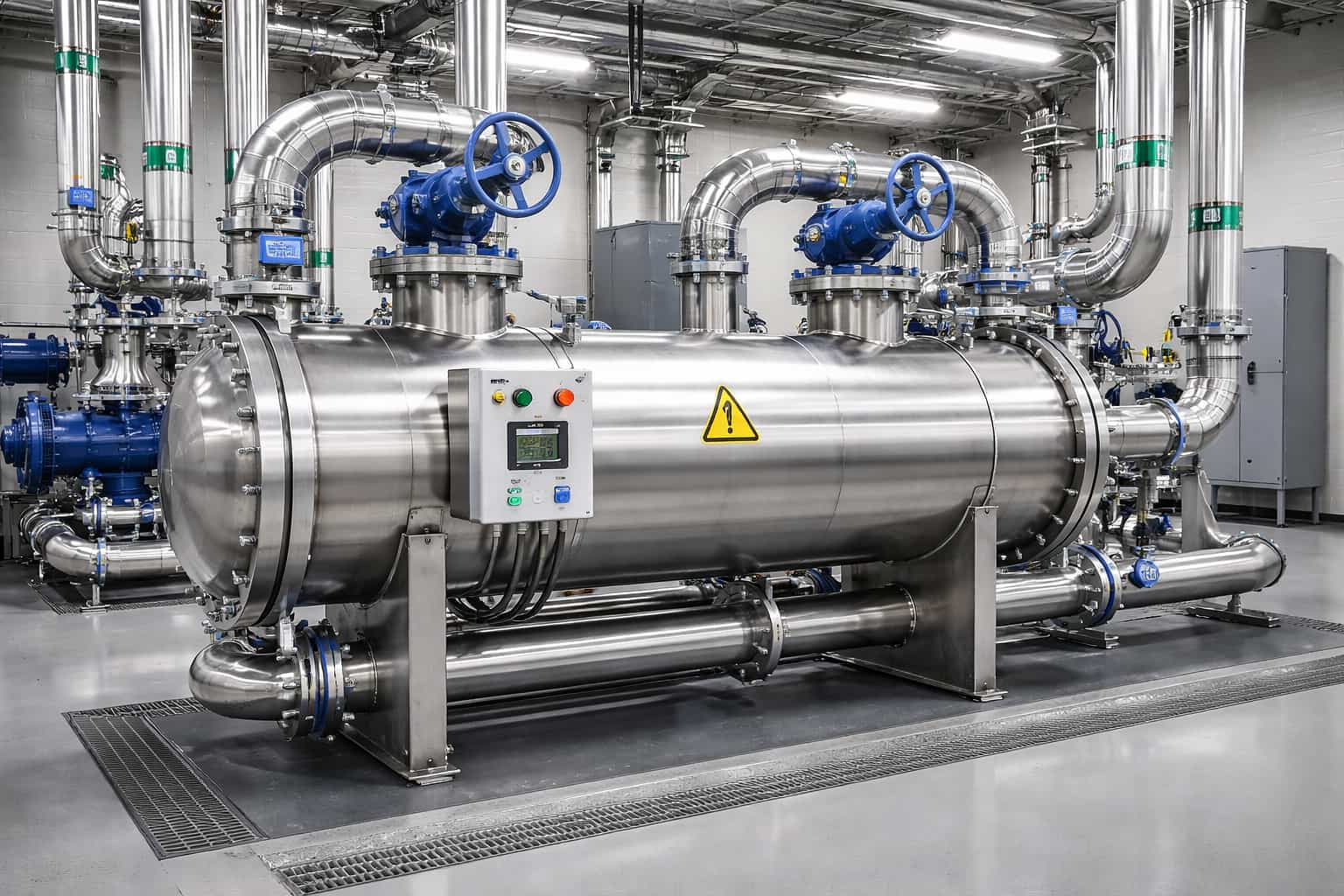
Understanding Why Closed Systems Corrode
The term 'closed' is somewhat misleading. While a true closed loop has no contact with the atmosphere, virtually every real-world closed cooling system has points of oxygen ingress: pressurized expansion tanks, makeup water connections, pump seal leakage, and periodic maintenance openings. Each of these pathways introduces dissolved oxygen (DO) into the circulating water - and dissolved oxygen is the primary driver of electrochemical corrosion in these systems.
The corrosion mechanism is straightforward. At anodic sites on carbon steel surfaces, iron is oxidized and releases ferrous ions (Fe²⁺) into solution. The electrons released at the anode travel through the metal to cathodic sites, where they react with dissolved oxygen to produce hydroxide ions (OH⁻). The overall reaction produces iron hydroxide, which further oxidizes to form hydrated ferric oxide - rust. Over time, these rust deposits accumulate on pipe walls and heat exchanger surfaces, reducing flow, degrading heat transfer efficiency, and creating underdeposit environments where pitting corrosion can accelerate.
The key point is this: remove the dissolved oxygen, and you dramatically reduce the electrochemical driving force for corrosion. This is not a new concept - mechanical deaerators and chemical oxygen scavengers have been used in power plant feedwater systems for decades. But nanobubble technology offers a new and highly effective method for achieving low dissolved oxygen levels in closed cooling circuits, without the temperature dependencies that limit conventional oxygen scavenger chemistry.
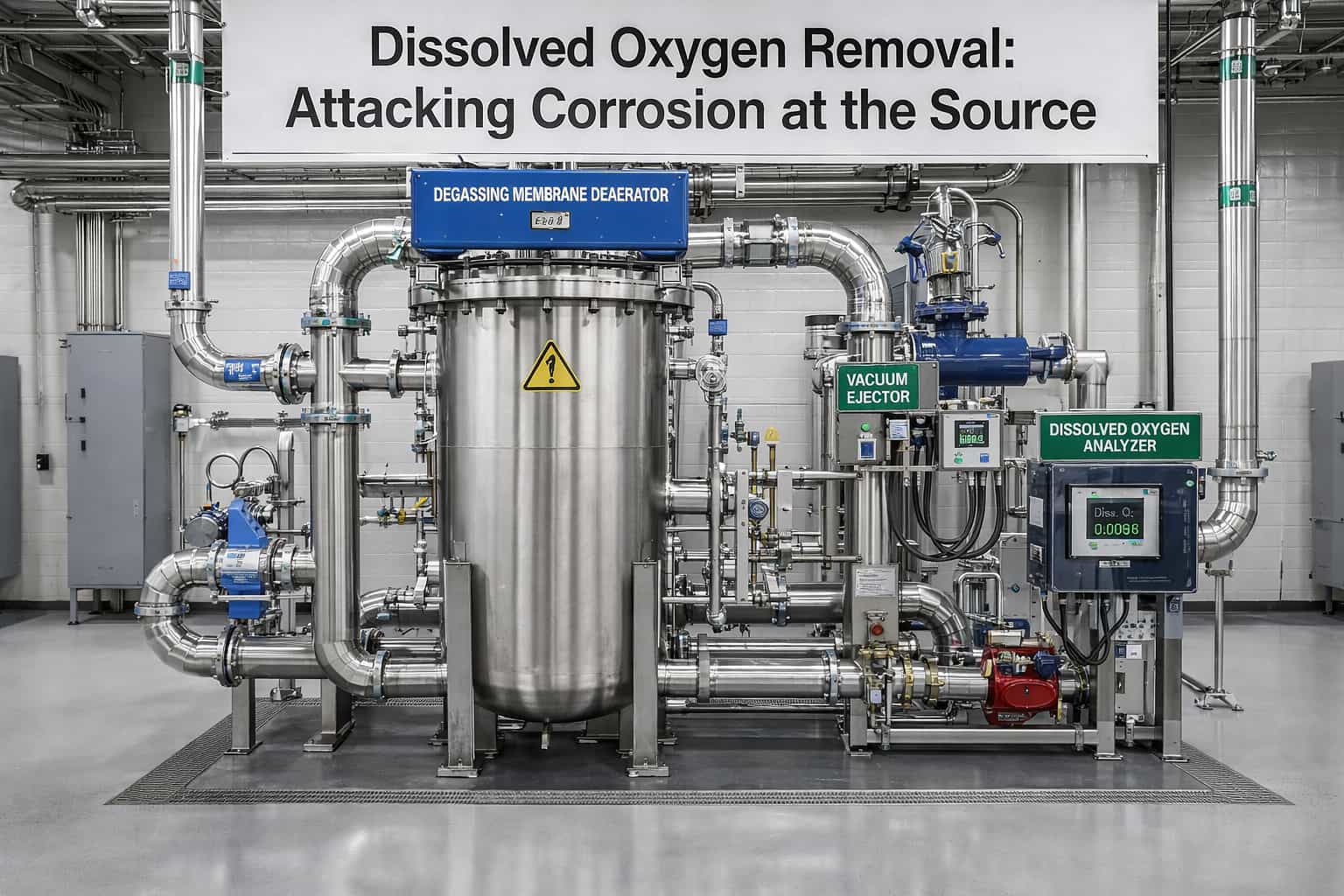
Dissolved Oxygen Removal: Attacking Corrosion at the Source
The most direct corrosion-control application of nanobubble technology in closed cooling systems involves the use of nitrogen nanobubbles to displace dissolved oxygen from the circulating water. This technique, sometimes referred to as nanobubble degassing or inert-gas purging, leverages Henry's Law: - when the partial pressure of an inert gas at the water's surface is elevated (as it is when nitrogen nanobubbles are introduced), the equilibrium solubility of oxygen drops, and DO migrates out of solution.
Unlike conventional nitrogen sparging - which requires large gas volumes, extended contact times, and may cause hydrodynamic disruption - nanobubble-based degassing is efficient, continuous, and achievable with a compact skid-mounted unit integrated into a sidestream of the cooling circuit. The TMC Nanobubble Series generators can be configured to run continuously on a bypass stream, maintaining dissolved oxygen at near-zero levels throughout the system loop.
The practical benefits of nanobubblers are significant:
- Nitrite and molybdate inhibitors both form protective oxide layers on carbon steel surfaces. When dissolved oxygen is removed from the system, the electrochemical driving force that those inhibitors must counteract is substantially reduced - meaning lower inhibitor dosages can maintain equivalent protection, reducing chemical costs and the risk of under- or over-dosing.
- The 'dangerous inhibitor' problem associated with nitrite - where an insufficient concentration in a large cathodic field leads to rapid localized pitting - is mitigated when the cathodic reduction of oxygen is itself suppressed. This is not an argument for eliminating nitrite monitoring, but it does provide an additional layer of protection against the consequences of transient chemistry excursions.
- During system shutdowns, which represent the highest-risk periods for oxygen ingress, a brief nitrogen nanobubble purge cycle prior to shutdown can significantly reduce the dissolved oxygen content of the system water before it cools and its oxygen-carrying capacity increases.
It is worth noting that molybdate inhibitors, unlike nitrite, actually require a residual level of dissolved oxygen to function effectively. The molybdate ion adsorbs onto iron oxide at anodic sites, and this oxide formation requires some oxygen. In practice, nitrogen nanobubble treatment is calibrated to reduce DO to a corrosion-suppressing level without driving it to absolute zero, preserving the function of molybdate-based programs where they are in use.
Biofilm and Microbiologically Influenced Corrosion
Microbiological control in closed cooling systems presents a distinctive challenge. In systems treated with nitrite as the primary corrosion inhibitor, the use of oxidizing biocides such as chlorine or bromine is counterproductive - these compounds will deactivate the nitrite residual and risk damage to system metals. Treatment programs therefore rely on non-oxidizing biocides applied periodically, targeting planktonic bacteria while acknowledging that biofilm communities are more difficult to penetrate and control, especially for wastewater facilities.
This is where ozone-charged nanobubbles offer a compelling advantage. Ozone (O₃) is a powerful oxidizing biocide, but when delivered as a dissolved gas in conventional concentrations, its distribution through a closed system is uneven, its half-life in water is short, and the risk of nitrite oxidation is real. Nanobubble delivery changes the equation entirely.
When ozone is dissolved into nanobubble form, the gas is encapsulated within stable, sub-200nm bubbles that remain dispersed throughout the entire system volume. The slow, controlled release of ozone from collapsing nanobubbles generates hydroxyl radicals (•OH) - among the most potent oxidizing species in chemistry - at concentrations and residence times that are far more effective against biofilm than conventional dosing approaches. The negative zeta potential of ozone nanobubbles further allows them to interact electrostatically with the positively charged extracellular polymeric substance (EPS) matrix of biofilm communities, disrupting the structural scaffold that protects bacteria from conventional biocides.
The specific organisms of concern in nitrite-treated closed systems - nitrifying bacteria (e.g., Nitrosomonas, Nitrobacter) and denitrifying bacteria - are addressed simultaneously. Nitrifying bacteria convert nitrite to nitrate, depleting the inhibitor residual; denitrifying bacteria can further reduce nitrate to nitrogen gas, both contributing to inhibitor loss and contributing to ammonia formation that elevates copper corrosion risk. Disrupting biofilm communities with ozone nanobubbles addresses both organisms at the biological level, rather than managing them through chemistry adjustment after the fact.
Critically, ozone nanobubble treatment can be applied in pulse or sidestream mode to avoid sustained high-concentration ozone exposure that could affect the nitrite residual.
Note that dosing strategy is a function of system volume, biofilm burden, and inhibitor program — TMC Fluid Systems provides application engineering support for system-specific integration.
What Are Nanobubbles?
Nanobubbles are gas-filled cavities in liquid with diameters typically ranging from 80 to 200 nanometers - well below the threshold of visible bubble formation and orders of magnitude smaller than conventional microbubbles. Their physical behavior is fundamentally different from that of larger bubbles and is responsible for their exceptional utility in water treatment applications.
Several properties make nanobubbles uniquely effective in closed cooling water systems:
- Extreme Surface Area-to-Volume Ratio: A nanobubble solution contains billions of bubbles per milliliter, providing an enormous gas-liquid interface for mass transfer and chemical reaction.
- High Internal Pressure and Stability: Due to the Laplace pressure effect, nanobubbles maintain their structural integrity in solution for hours to days, unlike larger bubbles that rise and escape within seconds.
- Strong Negative Zeta Potential: Nanobubbles carry a significant negative surface charge, which keeps them dispersed and prevents coalescence. This charge also plays a role in disrupting biofilm structures, as discussed below.
- Reactive Oxygen Species (ROS) Generation: When nanobubbles collapse, through shear, pressure change, or natural decay, they release hydroxyl radicals (•OH) and other reactive oxygen species that are powerful oxidizing agents effective against biological contaminants.
TMC Fluid Systems supplies nanobubble generator systems, engineered for industrial applications including closed cooling water treatment. These systems can be configured to generate nanobubbles with nitrogen, air, ozone, or other process gases depending on the application objective.
Scale, Deposits, and Heat Exchanger Efficiency
Even in well-maintained closed cooling systems, corrosion products and particulate matter accumulate over time. Iron oxide particles shed from corroding pipe walls circulate through the system and deposit on heat exchanger surfaces - both tube-and-shell and plate-and-frame designs - where they reduce thermal conductivity and create underdeposit environments for further corrosion. In glycol-containing systems, degradation products of ethylene or propylene glycol add to the deposit burden.
Conventional practice addresses this through sidestream filtration: cartridge or bag filters sized to capture sub-micron particulates on a continuous bypass stream.
Nanobubble treatment complements this approach in two ways:
- Surface-cleaning effect: The collapse of nanobubbles at or near solid surfaces produces localized microjet and shockwave energy sufficient to dislodge loosely adhered deposits from pipe walls and heat exchanger plates. This 'micro-cavitation' effect, operating continuously at low intensity, helps keep surfaces clean between maintenance cycles and reduces the rate at which particulate loading accumulates in filters.
- Particle agglomeration: In some configurations, nanobubbles have been shown to enhance the agglomeration of fine suspended particles into larger clusters that are more efficiently captured by sidestream filtration. This is particularly relevant for the iron oxide colloidal particles - often in the 0.1–1.0 µm range - that are the primary deposit-forming fraction in closed cooling systems.
For plate-and-frame heat exchangers, whose tight plate spacing makes them especially vulnerable to fouling and blockage, the combination of nanobubble surface treatment and enhanced filtration represents a meaningful extension of cleaning intervals and reduction in maintenance downtime.
Integration with Existing Chemical Programs
A recurring concern from plant water treatment engineers considering new technologies is whether the technology will disrupt or complicate an established chemistry program. Nanobubble treatment is not a wholesale replacement for corrosion inhibitor chemistry. Nitrite, molybdate, azoles, and pH buffers remain essential tools for closed cooling system protection, and their management requires the same disciplined monitoring and dosing control that experienced practitioners apply today.
What nanobubble technology provides is a set of upstream and parallel capabilities that reduce the demands placed on those chemical programs:
- Reduced dissolved oxygen lowers the electrochemical corrosion rate, allowing inhibitor programs to operate at the lower end of their recommended control ranges.
- Continuous biofilm disruption reduces the microbial consumption of nitrite, stabilizing inhibitor residuals between sampling intervals and reducing the frequency of corrective dosing events.
- Surface-cleaning and deposit control reduce the formation of underdeposit corrosion environments, improving the overall effectiveness of protective oxide layers formed by nitrite and molybdate.
Integration is achieved through a compact skid-mounted TMC Nanobubble Generator installed on a sidestream bypass of the closed cooling circuit - typically 5–15% of total system flow. The unit operates continuously or on a programmable cycle, with gas supply (nitrogen for DO control, ozone for biofilm) selected by application objective. The system requires no chemical storage, no chemical handling, and generates no byproducts requiring discharge management.
For facilities subject to increasingly stringent environmental regulations on nitrite, molybdate, or phosphate discharge - common in closed systems with significant leakage - the reduction in chemical demand that nanobubble treatment enables can directly support compliance objectives.
Application Considerations and Sizing
Closed cooling water systems vary enormously in volume, flow rate, metallurgy, operating temperature, and contamination history. No nanobubble application is one-size-fits-all, and a thorough site assessment is the starting point for any project.
Key parameters for system evaluation include:
- System volume and flow rate, which determine nanobubble generator capacity and sidestream sizing
- Baseline dissolved oxygen levels at multiple points in the circuit
- Existing inhibitor program and current control ranges
- History of biofilm or MIC events, including nitrate/ammonia trends
- Heat exchanger type, plate spacing, and cleaning history
- Glycol content and degradation status, if applicable
TMC Fluid Systems offers pre-project application consulting and, where appropriate, pilot testing protocols using labscale TMC Fluid Systems' Nanobubble Generator Series units to demonstrate DO reduction and biofilm control performance before full system commitment.
Conculsion
Corrosion in closed cooling water systems is not a solved problem. Despite decades of inhibitor chemistry development and increasingly sophisticated monitoring tools, failures continue to occur - often in systems that were thought to be well-managed. The reason, in most cases, is that conventional treatment programs manage corrosion chemistry after the fact rather than addressing the fundamental driver: dissolved oxygen and biological activity at metal surfaces.
Nanobubble technology offers a different approach. By reducing dissolved oxygen at the source, disrupting biofilm communities with precision-delivered ozone, and maintaining surface cleanliness through continuous micro-cavitation effects, nanobubble generators address the root causes of closed cooling system corrosion in ways that chemical programs alone cannot achieve.
The result is not a replacement for established practice, but a powerful complement to it - one that reduces chemical consumption, extends equipment service life, supports environmental compliance, and provides plant operators with an additional layer of protection against the consequences of chemistry excursions, leaks, and biological upsets.
For more information on TMC Nanobubble Generators and their application in closed cooling water treatment, contact us.
