
Wastewater Treatment
How are Nanobubbles being used for Wastewater Treatment
Nanobubbles are increasingly being adopted in the wastewater treatment industry due to their unique physical and chemical properties that enhance the efficiency, effectiveness, and sustainability of various treatment processes. Defined as gas-filled cavities smaller than 200-nm in diameter, nanobubbles differ significantly from conventional bubbles in that they remain suspended in liquid for extended periods, exhibit near-neutral buoyancy, and collapse in ways that generate beneficial chemical reactions. These attributes make them particularly valuable in municipal and industrial wastewater treatment systems.
One of the most significant advantages of nanobubbles is their ability to improve oxygen transfer efficiency (OTE). In conventional aeration systems, large bubbles rise rapidly to the surface and release oxygen into the atmosphere before it can be fully absorbed into the liquid. In contrast, nanobubbles remain dispersed within the water column for hours or even days, allowing for continuous and efficient diffusion of oxygen. This enhanced gas transfer supports aerobic microbial activity in biological treatment processes, such as activated sludge systems, sequencing batch reactors (SBRs), and membrane bioreactors (MBRs), where oxygen is essential for breaking down organic contaminants.
Another critical function of nanobubbles in wastewater treatment is their ability to generate reactive oxygen species (ROS) upon collapse. When nanobubbles are destabilized—whether through changes in pressure, temperature, or chemical conditions, they implode, releasing a burst of energy that forms hydroxyl radicals and other ROS. These species are powerful oxidizers that can degrade complex organic pollutants and assist in advanced oxidation processes (AOPs); any inactivation of bacteria and viruses depends on the gas used, dose, and contact time, and must be shown by lab or site testing.
In addition to enhancing biological and chemical treatment, nanobubbles also play a role in physical treatment processes. They improve flotation efficiency by increasing the surface area available for particle attachment. In systems such as dissolved air flotation (DAF), the presence of nanobubbles facilitates the agglomeration and removal of suspended solids, oils, and grease. Nanobubbles can also penetrate biofilms and sludge flocs; any effect on sludge digestion, sludge volume, dewatering, or sludge handling cost depends on the sludge, the gas used, and dose, and is evaluated per site.
From an operational perspective, nanobubble technology is relatively easy to integrate into existing treatment infrastructure. Nanobubble generators can be installed inline or as side-stream units and typically require minimal modifications to existing piping and tanks. They can be configured to use various gases, such as air, oxygen, or ozone, depending on the treatment objective. Energy use is assessed per site — any saving from reduced demand on blowers and mixers depends on duty, oxygen demand, and diffuser condition, and is evaluated on a full oxygen balance (kg O₂/h).
In summary, nanobubbles offer a multifaceted and energy-efficient solution for wastewater treatment. As water treatment facilities face growing challenges related to energy use, contaminant complexity, and environmental regulations, nanobubble technology represents a promising and adaptable advancement in the field.
Key Features
Exceptional Surface Area for Maximum Contact:
- Nanobubbles are incredibly small, resulting in a much higher surface area-to-volume ratio. This increases contact with contaminants at the microscopic level.
Suspended for Sustained Impact:
- Unlike conventional bubbles that rise and burst within seconds, nanobubbles remain suspended in water for extended durations. This stability supports longer contact between the gas and the water being treated.
Superior Gas Delivery Efficiency:
Nanobubbles improve the delivery of oxygen, ozone, and other treatment gases into water; the effect on purification and aeration is evaluated per site by OTE/SOTE and kg O₂/h.

How are Nanobubbles being used in the WWT Industry
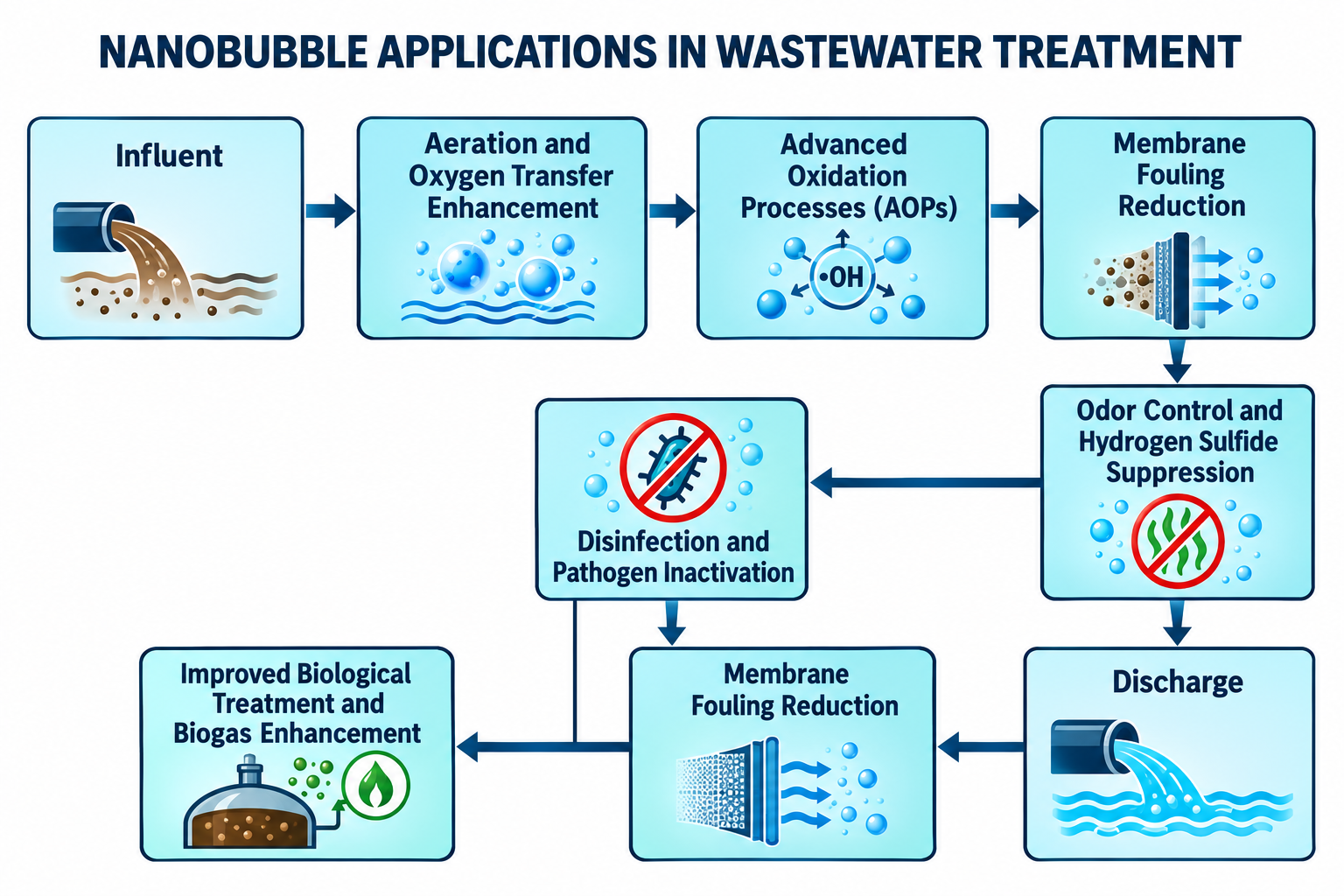
Nanobubbles are increasingly being used across multiple stages of wastewater treatment because of their unique physicochemical properties , extremely small size (<200 nm), high internal pressure, long stability in water, and ability to generate reactive oxygen species (ROS).
Here’s an overview of their applications in the wastewater treatment industry:
1. Aeration & Oxygen Transfer Enhancement
Nanobubble oxygenation can achieve higher oxygen transfer efficiency than conventional diffused aeration at the same duty, depending on diffuser condition, water chemistry, and gas supply; transfer is evaluated per site by OTE/SOTE and kg O₂/h, not as a general superiority claim.
Because nanobubbles remain suspended for long periods, they continuously dissolve oxygen, leading to:
- BOD and COD removal rates are evaluated per site by influent/effluent testing.
- Energy use is assessed per site — any saving depends on duty, oxygen demand, and diffuser condition, and is evaluated on a full oxygen balance (kg O₂/h), rather than a fixed percentage.
- Microbial activity in aerobic basins and MBBR/MBR systems depends on dissolved oxygen, load, and temperature, and is evaluated per site.
2. Sludge Reduction & Dewatering
- Nanobubbles (especially ozone or air nanobubbles) break down extracellular polymeric substances (EPS) that bind sludge flocs; the effect on a given sludge is evaluated per site.
- This improves:
- Dewatering efficiency, sludge volume, and disposal cost are evaluated per site.
- Digestibility in anaerobic or aerobic digesters is evaluated per site.
- Ozone nanobubbles also oxidize recalcitrant organics; any reduction in chemical-conditioner use depends on the sludge and dose, and is evaluated per site.
3. Advanced Oxidation Processes (AOP)
- Ozone and hydroxyl radical nanobubbles (•OH) play a key role in degrading persistent organic pollutants (POPs), pharmaceuticals, dyes, and endocrine-disrupting compounds (EDCs).
- Often integrated with UV or hydrogen peroxide for synergistic effects (e.g., O₃–H₂O₂–nanobubble AOP).
4. Disinfection and Pathogen Inactivation
- Nanobubbles generate reactive oxygen species (ROS) upon collapse, including hydroxyl radicals and superoxide anions.
- These radicals can damage bacterial cell walls and viral membranes; any pathogen inactivation depends on the gas used, dose, and contact time, and must be shown by lab or site testing:
Pathogen reduction, where required, is shown by lab or site testing.
5. Reduced Sulfur Compounds (H₂S and Mercaptans)
- Air or oxygen nanobubbles oxidize reduced sulfur compounds such as H₂S and mercaptans; any effect on odor depends on the compound, dose, and contact time, and is evaluated per site.
6. Membrane Fouling Reduction
- In MBR and RO systems, nanobubbles help:
- Oxidize organic residues, which can reduce biofilm formation; the effect is evaluated per site.
- Act at the membrane surface through microcavitation effects; any cleaning effect is evaluated per site.
- Effects on membrane lifespan and chemical cleaning frequency depend on feed water, gas, and dose, and are evaluated per site.
8. Aquaculture and Reuse Applications
- Treated effluent enriched with oxygen nanobubbles is used in fish hatcheries and hydroponics; effects on dissolved-oxygen stability, water clarity, and algae growth depend on the water and dose, and are evaluated per site.
Key Characteristics of Nanobubbles
Benefits of Nanobubbles in STP & WWTP
Superior Oxidation and Treatment Performance
- Accelerated Advanced Oxidation Processes (AOPs): Nanobubbles enable the formation of reactive oxygen species (ROS), including hydroxyl radicals (•OH), which oxidize persistent organic pollutants; removal of any specific pollutant is evaluated per site by influent/effluent testing.
- Elevated Contaminant Breakdown: With greater reactivity and expanded contact surface, nanobubbles can increase contact with dissolved contaminants; removal of any specific contaminant depends on the compound, dose, and contact time, and is evaluated per site by influent/effluent testing (for example BOD/COD and target-compound concentrations).
How Do Nanobubbles Work?
Advancing Wastewater Treatment Performance in STPs & WWTPs
- Stronger Oxidation Mechanisms: Nanobubbles play a pivotal role in intensifying oxidation processes by promoting the formation of reactive oxygen species (ROS), including hydroxyl radicals. These radicals oxidize organic compounds present in wastewater; removal of any specific compound is evaluated per site by influent/effluent testing.
- More Effective Pollutant Elimination: Thanks to their ultra-small size and enhanced surface activity, nanobubbles increase interaction with dissolved contaminants. Whether that shortens treatment time or improves removal of any specific pollutant depends on the compound, dose, and contact time, and is shown by influent/effluent testing; discharge compliance is determined by the site's permit limits, not by the technology.
