
Technical Evaluation of Nanobubble Ozone Failure at the Lincoln Memorial Reflecting Pool and the Requirements for a Scalable Algal Bloom Control System
Abstract
In June 2026, the Lincoln Memorial Reflecting Pool in Washington, D.C., turned bright green with algae just days after a $14.7 million renovation - despite a $1.7 million contract for nanobubble ozone water treatment awarded to Green Water Solutions (dba Greenwater Services), an Ohio-based company. As an Application Specialist in nanobubble technology and industrial water treatment, I was not surprised. The failure was not a failure of nanobubble science. It was a failure of engineering: specifically, of system sizing, hydraulic distribution design, sequence of operations, and nutrient load management. This paper identifies the primary technical causes of the treatment failure, presents the supporting calculations, and outlines what a properly engineered nanobubble water quality system for a body of water of this scale actually requires.
1. Background and Scope of the Problem
The Lincoln Memorial Reflecting Pool is one of the most recognizable bodies of water in the United States. Its physical parameters define the engineering challenge:
Parameter | Value |
|---|---|
Total Volume | 6.5-million gallons (24.6-billion liters) |
Length | 2,030-feet (618-meters) |
Average Depth | Less than 30-inches (0.76-meters) |
Surface Area | ~300,000 square feet (~27,870 m²) |
Exposure | Fully open to atmosphere, no cover or shade |
Location | Washington, D.C. (hot, humid, high UV summers) |
Algae bloomed visibly within one day of the pool being refilled with water following the renovation. Federal agencies deployed both hydrogen peroxide and the Green Water Solutions nanobubble ozone system reactively - against an already established bloom. As of the date of this writing, the pool remains compromised and a second drain is being planned.
In a nut shell, nanobubble ozone technology is scientifically sound and well-validated for algae control. The NICO Series Nanobubble Generators Systems have demonstrated quantifiable results across aquaculture, wastewater treatment, lake restoration, and industrial water treatment. The problem at the Reflecting Pool is not the physics of nanobubbles. The problem is that a valid technology was applied without the engineering rigor the application demands.
2. Root Cause Analysis
In my opinion, the outcome was driven by six (6) distinct engineering failures. These failures compounded one another; although any single failure might have been manageable with sufficient design margin, their combined effect made the final failure inevitable.
2.1 Ozone Dose Rate Undersizing
This is the primary technical failure. Effective algae cell destruction by ozone is defined by the contact time (CT) value, where C is the the product of ozone concentration (mg/L) and T is the contact time (minutes). For green algae under warm summer conditions, a minimum CT value of 0.5 to 2.0 mg·min/L is required depending on species, cell density, and water chemistry.
The required ozone generation rate for the Reflecting Pool can be estimated as follows:
Volume of Pool
6,500,000 gal × 3.785 L/gal = 24,602,500,000 L
Target O₃ Residual
0.10 mg/L (conservative; higher targets more effective)
Ozone Demand
(initial saturation only)
O₃ required = 24.6 × 10⁹ L × 0.10 mg/L = 2,460,250,000 mg = 2,460 kg
Ozone Half-Life in Warm Water
(~25°C/77°F ): ~15–20 minutes
Continuous Generation Needed
(to maintain residual against decay)
Rate ≥ 2,460 kg ÷ 20 min × 60 = ~7,380 kg/hr (worst case)
Practical Minimum Target Rate
(accounting for atmospheric off-gassing, UV photolysis, and organic ozone demand from algae biomass)
500–800 g/hr at minimum for a system of this scale in summer conditions

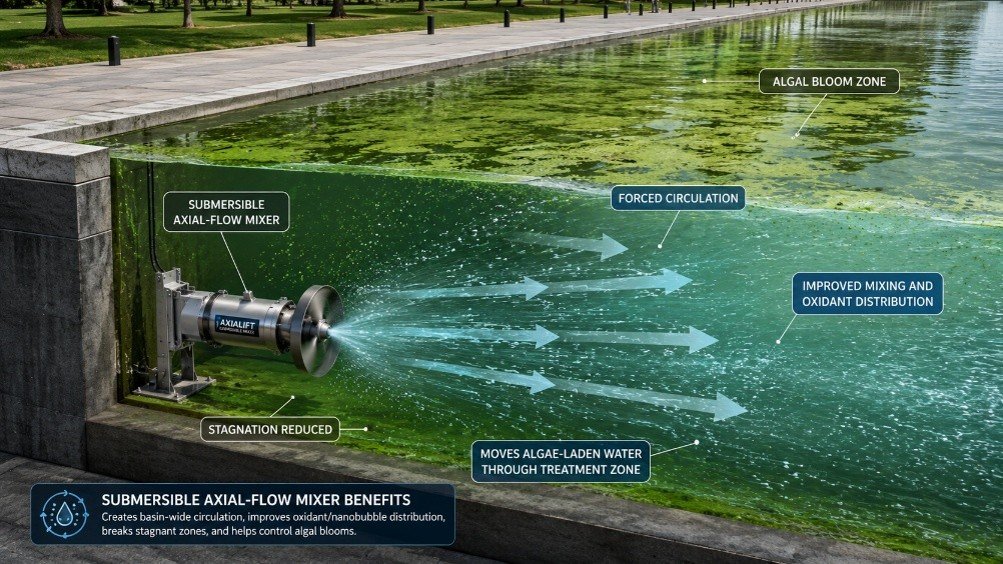
In a 2,030-foot-long open pool without forced flow, the effective treatment zone from each injection point would be limited by diffusion, weak natural convection, wind-driven surface movement, and local density currents. These mechanisms are insufficient to provide uniform distribution across the full basin length. As a result, the areas furthest from the injection points would remain poorly treated or effectively untreated.
Photographs from the June 2026 remediation effort appear to support this hydraulic limitation. The center portion of the pool, which was furthest from the visible injection locations, remained the most visibly affected area throughout the treatment period. This is consistent with an under-mixed system where oxidation occurs only near the injection zones, while the central basin remains outside the effective treatment envelope.
For this pool geometry, a properly engineered nanobubble–ozone system would require distributed circulation and injection, not only ozone generation capacity. At minimum, 6 to 8 submersible axial-flow circulation pumps should be installed along both sides of the pool to create longitudinal and cross-sectional movement. The design objective should be full-volume turnover every 4 to 6 hours, with nanobubble–ozone injection provided at each pump intake or immediately upstream of each circulation zone.
Without this distributed hydraulic mixing strategy, increasing ozone generation alone will not resolve the core engineering problem. The limiting factor is not only oxidation capacity; it is mass transfer, contact efficiency, and basin-wide distribution. In a stagnant open-water geometry, ozone cannot be expected to perform effectively unless the water itself is actively transported through the treatment zones.
2.3 Premature Refill - Reactive Deployment Against an Established Bloom
It has been reported that the pool was refilled before the permanent nanobubble purification system was fully installed, commissioned, and performance-verified. This represents a critical sequence-of-operations failure.
For a water body with a known history of algal growth, the correct commissioning protocol should be as follows:
- Install and commission the complete treatment system before introducing water into the basin.
- Treat the incoming fill water inline during pool charging to establish initial oxidative control before atmospheric inoculation begins.
- Verify measurable residual ozone or oxidation potential at the hydrodynamically weakest location, particularly the center of the pool, before declaring the system operational.
- Open the pool to normal atmospheric exposure only after treatment uniformity has been confirmed.
- Continue treatment strictly until the entire pool volume has been recirculated and exposed to the nanobubble–ozone treatment cycle.
Instead, the pool appears to have been filled first, allowing algal inoculation from supply lines, residual contamination, and atmospheric deposition to occur within the first 24 hours. The treatment system was then brought online only after bloom initiation had already begun.
This distinction is technically significant. Preventing algal establishment requires a much lower oxidant demand than remediating an active bloom. Once algae have proliferated, the oxidant requirement can increase by 10 to 100 times, depending on biomass concentration, organic loading, nutrient availability, and hydraulic mixing efficiency.
In effect, a system intended for preventive maintenance was deployed immediately under remediation conditions. This mismatch between design intent and actual operating condition would severely compromise treatment effectiveness from the first day of operation.
2.4 Nutrient Loading - The Fuel Source Was Never Addressed
Ozone oxidizes and kills algae cells. It does not remove dissolved nutrients from the water column. This distinction is critical and is frequently overlooked in field deployments. When an ozone system lyses algae cells, the intracellular contents (phosphorus, nitrogen, and organic carbon) are released back into solution. Those dissolved nutrients immediately feed the next generation of algae. This is the nutrient recycling loop, and it is the reason that ozone alone, without a nutrient removal step, cannot produce lasting algae suppression in a high-nutrient water body.
The Reflecting Pool is known to be supplied from either the Tidal Basin (naturally nutrient-rich from urban and stormwater runoff) or Washington D.C. municipal water. Many municipal water systems add orthophosphate compounds as corrosion inhibitors to prevent lead and copper leaching from aging pipes. These orthophosphates accumulate in the filled pool as a direct phosphorus source for algae growth. Without knowing the source water orthophosphate concentration and without a phosphorus removal component in the treatment design, the nutrient loading problem is left completely unaddressed. Therefore, nanobubble technology should be combined with effective nutrient removal or stabilization process.
A nanobubble ozone system that kills algae without removing the dissolved phosphorus and nitrogen feeding the algae is, at best, a holding action. It manages symptoms. It does not solve the problem. Permanent algae suppression in a body of water this size requires nutrient removal as an integrated component of the treatment train.
2.5 Thermal and Photochemical Load Underestimation
The 2026 renovation directed the pool floor to be painted a dark navy blue. The thermal consequences of this decision appear not to have been incorporated into the treatment system design.
Dark pigment absorbs substantially more solar radiation than the original light concrete substrate. In Washington D.C. in June, with ambient air temperatures above 85°F and direct solar irradiance of approximately 800–1,000 W/m², the water temperature in the shallow pool (average depth: 30 inches) rises rapidly. This has two compounding effects:
- Algae metabolic rate and reproductive cycle accelerate exponentially with increasing temperature. Green algae populations can double every 12 to 24 hours at elevated summer temperatures.
- Ozone solubility in water decreases with temperature (Henry’s Law). At 25°C, ozone solubility is approximately 50% of its value at 10°C. Warmer water holds less ozone. Simultaneously, UV photolysis from intense sunlight destroys dissolved ozone faster at the open water surface.
The net effect is a double penalty: the algae grow faster and the ozone is less effective. A system designed using performance data from enclosed, temperature-controlled pilot deployments will be significantly undersized for this real-world summer condition.
2.6 No Baseline Water Quality Characterization
A valid ozone dose calculation cannot be performed without baseline water quality data. The minimum required characterization for a nanobubble ozone system design includes:
- Total Organic Carbon (TOC) - determines instantaneous ozone demand; higher TOC means more ozone consumed before any residual is available for algae treatment
- Total Nitrogen (TN) and Total Phosphorus (TP) - establishes the nutrient loading and determines whether nutrient removal must be part of the treatment train
- Orthophosphate (PO₄³⁻) - direct algae nutrient, critical to measure in source water
- pH and temperature profile - both affect ozone chemistry and algae growth rate
- UV transmittance at 254 nm - determines photolysis rate for ozone dose correction
- Algae species identification and cell count - different species have different CT requirements; cyanobacteria require higher CT values than green algae
As of the time of this writing, the National Park Service has not publicly confirmed which water source was used to fill the pool, and the species of algae present has not been officially identified. If the contractor did not have this baseline data before sizing the system, the dose calculation had no scientific foundation.
The United States International Boundary and Water Commission’s (USIBWC) summary of the Tijuana River pilot reportedly stated that significant equipment design modifications would be necessary for effective scale-up. This finding was available before the Reflecting Pool contract was awarded.
From an engineering due-diligence standpoint, that conclusion should have triggered a full application-specific redesign before deployment in a substantially different hydraulic environment. The Reflecting Pool represents a different treatment geometry, volume, mixing condition, exposure pathway, and performance requirement compared with the original pilot context.
The technically appropriate response would have been to complete a formal scale-up design review, including hydraulic distribution, oxidant demand, contact time, equipment capacity, mixing strategy, and commissioning protocol. However, there does not appear to be any publicly available evidence confirming that such a redesign was completed before implementation.
3. Scale-Up Extrapolation Errors
It has been reported that Green Water Solutions' prior government deployment was a pilot study on bacterial contamination in the Tijuana River, where the system reportedly achieved a 91.5% reduction in total coliform and 83.8% reduction in E. coli over a six-week period. These are credible results for a bacterial target. However, the extrapolation from that pilot to the Reflecting Pool involves multiple compounding errors:
Parameter | Tijuana River Pilot | Reflecting Pool | Implication |
|---|---|---|---|
4. What a Properly Engineered System RequiresTarget Organism | Bacteria (E. coli, coliforms) | Green Algae (Colonial) | Algae Require 5x to 10× higher CT values |
Water Volume | Flowing River Segment | 6.5-M gallons static | Static volume requires full-volume dosing |
Body Geometry | Open channel (natural mixing) | Stagnant 2,030-ft basin | No natural mixing; requires recirculation design |
Containment | Open river | Open-air basin | Comparable atmospheric loss |
Season / Temp | Sept–Oct (cooler) | June (peak summer) | Higher temp = less O₃ solubility, faster algae growth |
USIBWC finding | Pilot successful | - | "Significant design modifications required for scale-up" |
4. What a Properly Engineered System Requires
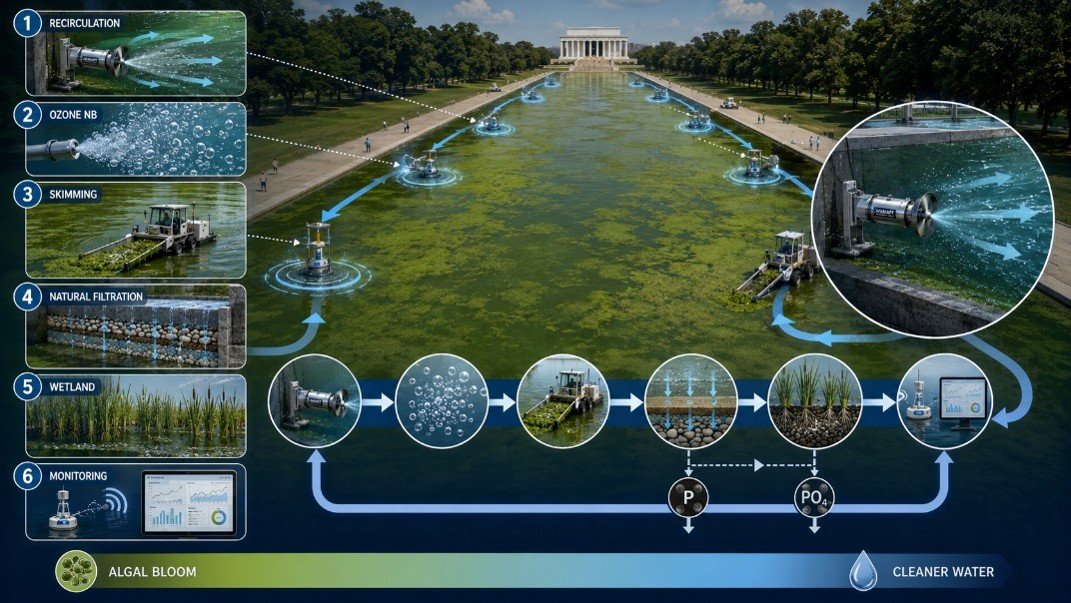
Sustainable algae management in the Lincoln Memorial Reflecting Pool cannot be achieved by a single technology deployed in isolation. It requires a multi-layer treatment train in which each component addresses a distinct failure mode. The following five-layer architecture represents the engineering baseline for a body of water with this geometry, nutrient loading, and public visibility requirement.
Layer | Technology | Address |
|---|---|---|
1 | Active recirculation - 6 to 8 submersible axial-flow pumps distributed along pool length | Creates basin-wide water movement and eliminates stagnant/dead zones |
2 | Properly sized ozone nanobubble system integrated at mixer intake / circulation points | Oxidative control of algae, pathogens, odor-causing compounds, and dissolved organics |
3 | Surface skimming and physical removal of dead algal biomass | Removes floating algae, scum, and oxidized biological solids |
4 | Natural sand–gravel–pebble filtration barrier on the recirculation loop | Removes suspended solids, fine algae particles, turbidity, and organic debris |
5 | Constructed wetland / vegetated side-stream polishing cell | Long-term nutrient reduction, especially phosphate and nitrate control |
6 | Phosphate-specific polishing media such as iron-coated sand, laterite, activated alumina, or calcium-based media | Removes dissolved orthophosphate, the key nutrient driving algal regrowth |
7 | Online monitoring and control system | Tracks treatment performance and prevents blind operation |
Equipment Sizing Guidance
As a starting-point design basis for a 6.5-million-gallon open-air pool in Washington D.C. summer conditions:
- Ozone generation capacity: minimum 500 g/h, target 800 g/h, with redundant N+1 generator configuration
- Recirculation flow rate: minimum 1,000 to 1,500 gallons per minute to achieve full-volume turnover in 4 to 6 hours
- Nanobubble bubble size: below 200 nanometers at point of generation, confirmed by Nanoparticle Tracking Ananlyzer (NTA)
- Dissolved ozone residual target: 0.05 to 0.10 mg/L at the pool center, measured continuously by in-situ amperometric sensors
- Phosphorus removal target: source water orthophosphate below 0.020 mg/L before fill
Monitoring and Verification Protocol
A system of this public significance requires continuous monitoring, not periodic visual inspection. The minimum instrumentation package:
- Continuous in-situ dissolved ozone sensors at three locations: both ends and pool center
- Continuous turbidity and chlorophyll-a fluorescence sensors at the same three locations
- Weekly laboratory analysis: total nitrogen, total phosphorus, orthophosphate, TOC, and algae cell count with species identification
- Real-time data logging with alarm thresholds and automated generator response
5. Immediate Recommendations
For the National Park Service and the Department of Interior, the following engineering recommendations are provided in priority order:
Short Term (Before Re-Fill)
- Drain the pool fully - the only reliable way to break the nutrient recycling loop with an established bloom of this scale
- Pressure wash and vacuum the painted floor to remove biofilm from the new paint surface, which serves as the primary re-inoculation reservoir
- Collect and analyze source water (both Tidal Basin and D.C. municipal supply) for orthophosphate, TN, TP, and TOC before any refill decision
- If municipal water is used for refill, install inline phosphorus removal (phosphate specific filtration medium) on the fill line
Medium Term (Permanent System Design)
- Issue a competitive technical solicitation for a full Six-layer treatment train as described in Section 4 - not a single-technology solution
- Require that any responding contractor provide: baseline water quality characterization, a CT value calculation for the target organism specific to this application, hydraulic modeling of the recirculation design, and a pilot or reference case study at comparable scale
- Establish a performance specification (e.g., chlorophyll-a below 10 μg/L at pool center, algae cell count below 1,000 cells/mL) rather than a technology specification - this allows competition on engineering merit
6. Conclusion
The algae bloom at the Lincoln Memorial Reflecting Pool in June 2026 was not an act of sabotage, nor was it an inevitable consequence of the renovations, nor was it a failure of nanobubble science. It was the predictable result of deploying a valid technology without adequate engineering: undersized ozone generation, no hydraulic distribution design, a reversed sequence of operations, unaddressed nutrient loading, and no baseline characterization to anchor the dose calculation.
Nanobubble ozone technology, properly engineered, is one of the most effective tools available for algae management in open water bodies. It generates no harmful chemical residuals. Its byproduct is oxygen. It is safe for the wildlife and waterfowl that use the pool. It does not require the chlorine concentrations associated with conventional swimming pool treatment. When sized correctly, recirculated properly, and integrated with nutrient removal and filtration, it can provide durable, low-maintenance water quality for a high-visibility public landmark. The question was never whether the technology could work at the Reflecting Pool. The question was whether anyone was going to engineer it correctly.
The answer, in this case, was no. The path forward is to do the engineering right.
