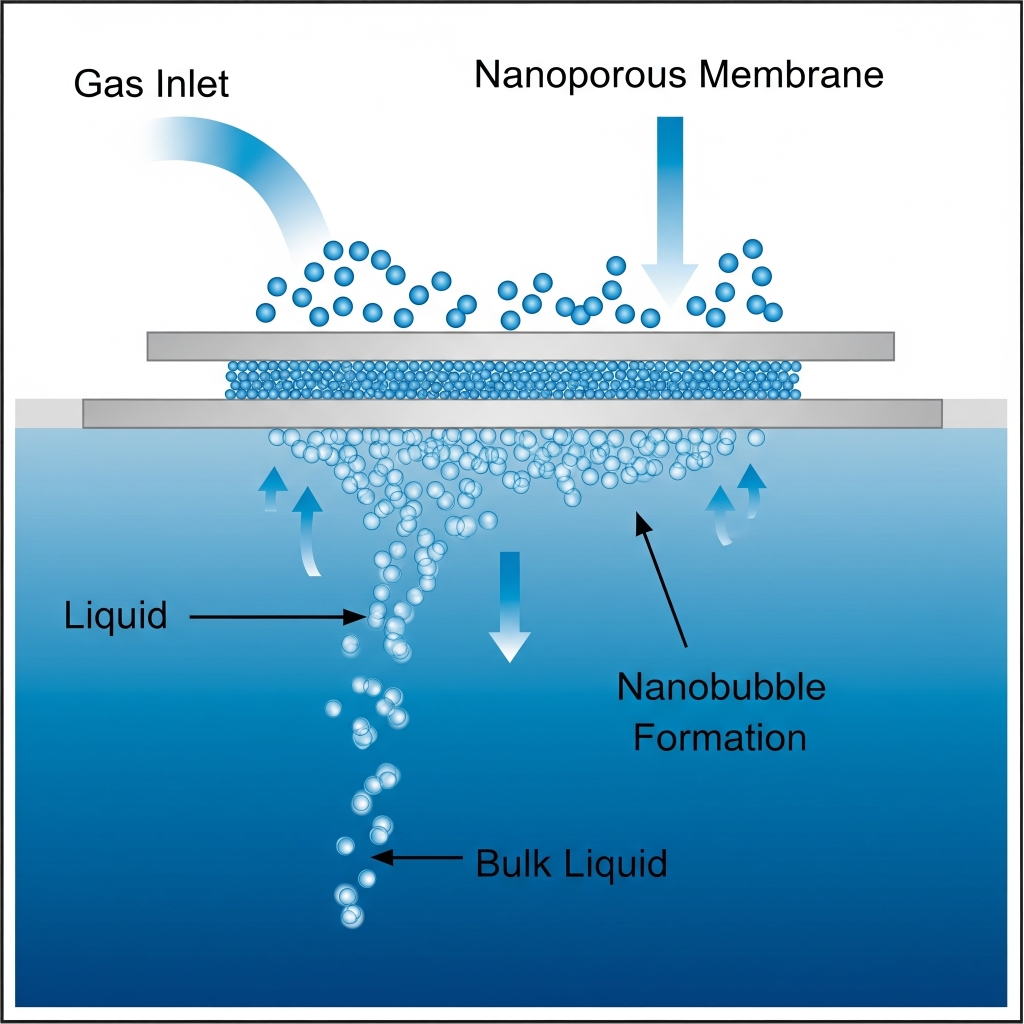
Nanobubble Creation via Membrane Sparging: A Technical Overview
Membrane sparging, also known as using nanoporous membranes, is a precision method for generating exceptionally small and stable nanobubbles. Unlike other methods that rely on bulk fluid dynamics or electrical fields, this process uses a physical barrier to control the bubble size with a high degree of uniformity. This method is particularly valued for applications requiring a narrow size distribution of nanobubbles.
Pressurized Gas–Liquid Mixing: The Process in Detail
How It Works – Step-by-Step
- Gas Supply
- Pure or blended gases (air, O₂, CO₂, H₂, or ozone) are fed into a pressurized chamber beneath a hydrophobic or hydrophilic nanoporous membrane.
- Nanoporous Membrane
- The membrane (pore size: 20–200 nm) allows controlled gas diffusion into the adjacent water phase.
- Materials may include PTFE, ceramic, stainless steel, or polymer composites.
- Pore geometry and surface energy are critical to maintaining stable nanobubble formation.
- Bubble Formation at Pore Mouths
- When gas pressure exceeds the liquid-side hydrostatic pressure + capillary entry pressure, gas exits the pores in a dispersed fashion.
- The bubble diameter depends on pore size, surface tension, and gas pressure. With appropriate design, nanobubbles (<200 nm) are consistently formed.
- Nanobubble Release and Stabilization
- As bubbles detach from the pore and enter the bulk liquid, shear forces, Brownian motion, and interfacial energy stabilize the nanobubbles.
- Nanobubbles remain suspended due to their near-neutral buoyancy, high zeta potential, and internal Laplace pressure.
Key Features
|
Feature |
Description |
|
Precision Control |
Uniform pore size enables tight control over bubble diameter |
|
Low Energy Requirement |
Operates at moderate pressures (1–4 bar), no mechanical shearers needed |
|
Chemical Compatibility |
Membranes can be tailored for aggressive gases like ozone or CO₂ |
|
Scalable Modules |
Can be stacked in flat sheets, hollow fibers, or tubular modules |
|
Gas Selectivity |
Permits the use of high-purity or mixed gas streams for targeted outcomes |
Industrial Applications
|
Industry |
Use Case |
|
Wastewater Treatment |
Improves DO levels, biofilm disruption, BOD/COD reduction |
|
Aquaculture |
Delivers oxygen-rich water for healthier aquatic life |
|
Agriculture |
Promotes root zone oxygenation and fertilizer uptake |
|
Food & Beverage |
Enhances sanitation with ozone nanobubbles |
|
Electronics / Semiconductors |
Ultrapure water degassing, precision rinsing |
|
Pharmaceutical |
Clean-in-place (CIP) efficiency, product stability |
Conclusion
The synergy between electrolysis and pressurized gas–liquid mixing offers a scalable, chemical-free, and energy-efficient way to generate stable nanobubbles. This method is especially valuable for plant and operations managers seeking to improve treatment performance, reduce chemical dosing, and support sustainable industrial processes.