Nanobubble Creation via Hydrodynamic Cavitation: A Technical Overview
Hydrodynamic cavitation is a highly effective and scalable physical process used to generate a high concentration of stable nanobubbles. This method leverages fluid dynamics to create localized low-pressure zones within a liquid, inducing the formation and subsequent collapse of microscopic vapor cavities, which ultimately lead to the creation of nanobubbles.
Hydrodynamic Cavitation: The Process in Detail
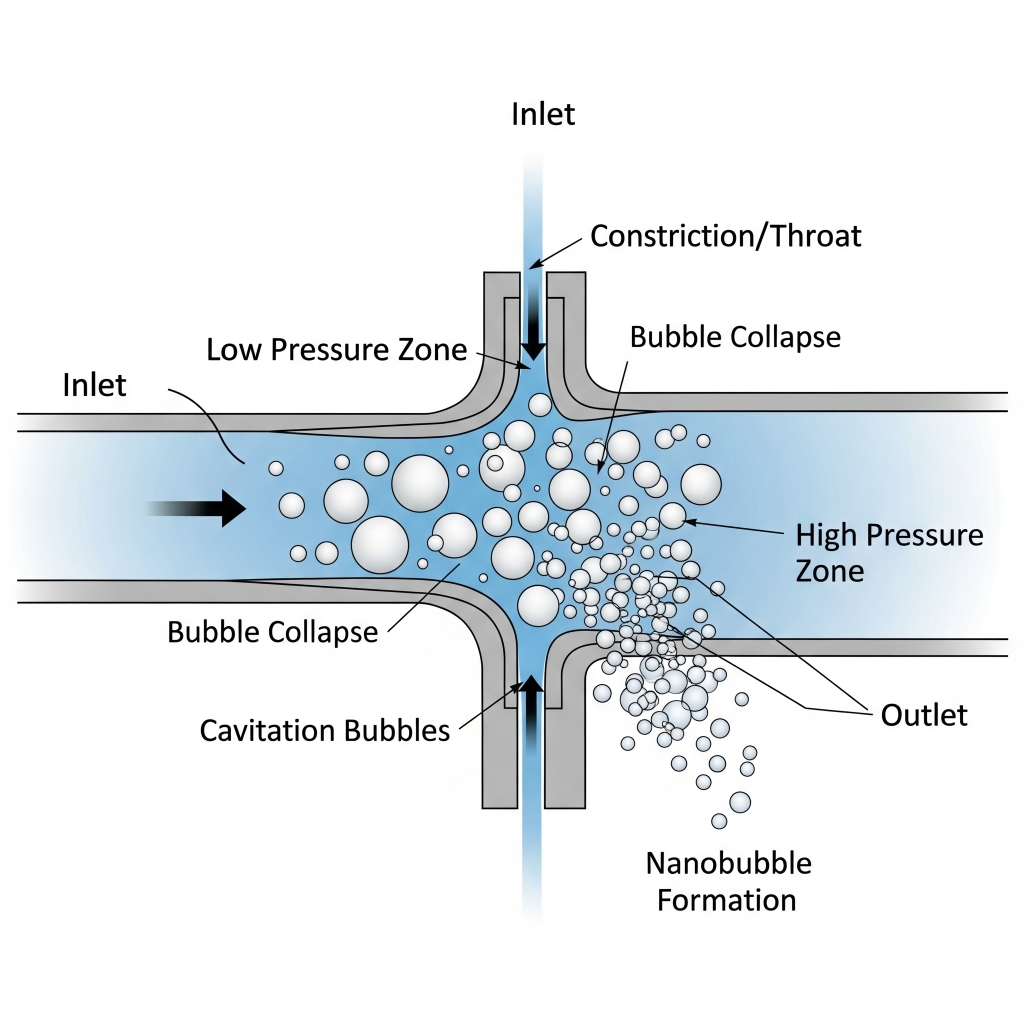
- System Setup: The process begins with a fluid (e.g., water) being pumped at high velocity through a specialized reactor or a cavitation device. This device typically contains a constricted flow path, such as an orifice plate, a Venturi tube, or a carefully designed nozzle.
- Pressure Drop and Cavitation: As the high-velocity fluid enters the constriction, its kinetic energy increases at the expense of its potential energy, causing a sharp drop in static pressure. According to Bernoulli's principle, this pressure drop is inversely proportional to the fluid velocity. If the pressure drops below the fluid's vapor pressure, the liquid boils locally, forming a multitude of small vapor cavities or bubbles. This phenomenon is known as hydrodynamic cavitation.
- Bubble Formation and Growth: Within this low-pressure zone, gases dissolved in the liquid, along with water vapor, nucleate and form these cavitation bubbles. The bubbles grow rapidly in size as they remain in this low-pressure region.
- Implosion and Nanobubble Formation: As the fluid exits the constriction and moves into a wider channel, its velocity decreases, and the static pressure recovers dramatically. This sudden increase in external pressure causes the cavitation bubbles to violently implode or collapse. This implosion is not a gentle process; it generates extremely high temperatures (thousands of Kelvin) and pressures (thousands of atmospheres) in a micro-environment. The intense energy released during this collapse shears the larger bubbles into countless, much smaller nanobubbles.
- Stabilization of Nanobubbles: The key to this process is the creation of incredibly small bubbles. Due to their size, the surface tension force on these bubbles is significantly higher than the buoyant force. This high surface tension gives nanobubbles a negative zeta potential, which means they repel each other and resist coalescence. This electrostatic repulsion, combined with their low buoyancy, prevents them from rising and bursting, leading to an extended lifespan—often weeks or months—within the liquid.
Key Benefits and Applications:
- High Concentration: Hydrodynamic cavitation is highly efficient and can produce a very high concentration of nanobubbles, which is crucial for many industrial applications.
- Scalability: The technology is scalable, with systems ranging from small laboratory setups to large-scale industrial plants.
- Versatility: The process can be tuned to work with various liquids and gases, making it applicable across a wide range of industries, including water treatment, agriculture, food and beverage, and biotechnology.